Introduction
Research has become an increasingly important aspect of all medical specialties in recent years. Increasing numbers of applicants are drawn towards more competitive specialties such as orthopedic surgery every year, and research is often a large way to set themselves apart from the rest of the field. Additionally, scholarly activity is a universal requirement across all orthopedic surgery residencies, with a majority of residency programs requiring that their residents publish or present at least one project prior to graduation.1–3 Research is also thought to improve residents’ understanding of evidence-based medicine, biostatistics, and critical thinking skills, while also increasing engagement with faculty.2 Developing the habit of staying up to date on current literature and applying those principles to improve patient care is also the ultimate goal of encouraging scholarly activity.2 Furthermore, it has been shown that having a heavier research background increases chances of NIH funding for academic orthopedic surgeons, creating opportunities for scientific breakthroughs.4
Previous studies have hypothesized that increased protected time and increased research funding were more likely to get residents involved during residency. Williams et al supported this hypothesis by finding that any program with dedicated research time had residents who significantly published more than the programs which did not.2 Additionally, Thomas et al investigated the research productivity of a residency program before and after implementing a research track, finding that those in the research track were significantly more likely to have at least one publication, with higher mean publications per resident and more publications per residency year.5
Following training, orthopedic surgeons who choose to go into academic practice continue to have research requirements to maintain their positions or receive promotions.4,6 They also often help train residents, which may lead to more participation in research.4,6,7 On the other hand, those who go into private practice are not as frequently affiliated with residency programs, although several private practice orthopedic surgeons still choose to participate in teaching residents or medical students in a “privademic” setting. In these settings, orthopedic surgeons may receive the research infrastructure of an academic center while enjoying the benefits of private practice.7
While research remains an integral component of the academic journey from medical school to fellowship, it is not yet clear how lasting the effects of research are on future scholarly activity or academic involvement. Rompala et al studied the association between publications before and during residency and fellowship for shoulder and elbow surgeons and found that those who published more in training were more likely to publish more in practice.8 The study did not find that total publication count and attending publication rate were associated with residency location.8
Several orthopedic residencies are now incorporating a dedicated research year into the curriculum, in which one of the primary duties of the residents is to complete research projects. This year is thought to strengthen academic involvement of the residency program as well as build the curriculum vitae necessary for a competitive fellowship match and future career opportunities. The purpose of this study was to investigate whether the completion of a research year at a single institution is predictive of increased scholarly activity and inclination towards academic medicine following training.
Methods
Following approval from Wright State University’s Institutional Review Board (IRB), a survey was sent out to all graduates of the residency program via email in September 2024. The survey was created specifically for this project and was therefore not tested for validity. The survey asked whether the participant was a research resident or a categorical resident prior to asking a series of questions which were specific to research residents regarding the influence of the research year towards scholarly activity, practice setting, and teaching opportunities as well as a series of common questions for both groups of alumni. The survey questions included binary and five-point Likert scale response options (Supplement). For those alumni who did not respond to the survey, number of publications and current practice setting and location were found through an online search. Publications per year since graduation and practice setting were compared between both groups, as were answers to the survey questions. Between-groups comparisons were made using independent samples t-tests (continuous variables) or chi square tests (categorical/ordinal variables).
Results
A total of n=82 graduates were included in the study (61 categorical and 21 research), and a total of n=32 graduates (20 categorical and 12 research) completed the survey (39% response rate). The descriptive statistics of all alumni outcomes are shown in Table 1. Mean publications per year were 0.35 and 0.28 for the research group and categorical group, respectively, and the difference was not statistically significant (p=0.624). Whereas 16.4% of categorical resident graduates currently worked in academic settings, just 4.8% of research resident graduates did so. In contrast, 90% of research resident alumni currently practiced in private settings, versus 79% of categorical alumni. Practice setting distributions dd not differ significantly between the two groups (χ2=2.28; p=0.728).
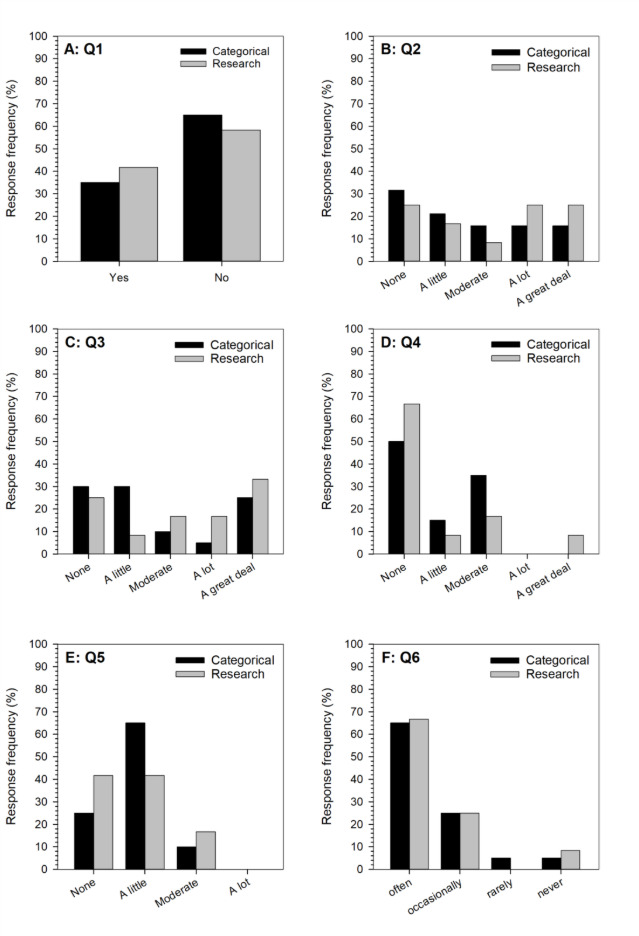
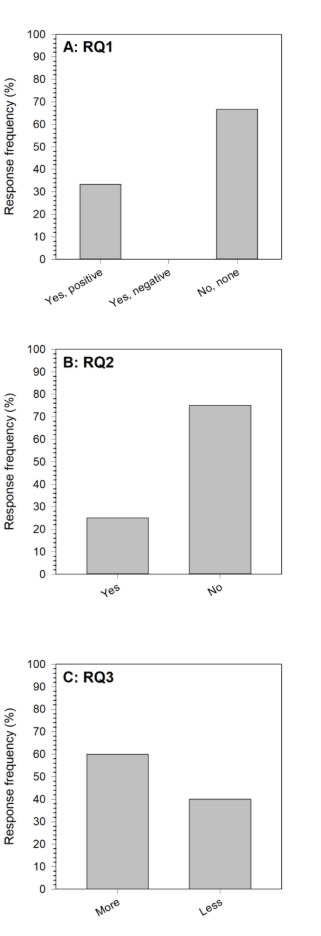
Among survey respondents, 66% of research resident alumni noted that the research year did not affect their choice to teach residents or medical students, nor which type of practice setting they eventually joined. Half of research resident respondents believed the research year made them more inclined to pursue research, while the other half reported that it either made them negatively inclined or did not affect them at all. A higher number of alumni in both groups do not hold academic positions in their institution than those who do. Most survey respondents in both categories answered that they do come up with clinical questions in their own practice “often” or “occasionally”. None of the survey question response frequencies differed significantly between groups (for each, p≥0.362). See Figures 1 and 2 for response frequencies.


Discussion
Our study showed that research productivity in our alumni was less than one publication per year and was also not statistically significant between former research residents and former categorical residents. Additionally, our data showed that most alumni, both categorical and research, ultimately chose to practice in a private setting. The research year did not appear to significantly affect which type of practice the graduates joined, which is reflected in those numbers. The research year also did not appear to affect one’s likelihood of working with residents, which often ties into academics.
We should keep in mind that some graduates may weigh other factors more heavily than their inclination to do research when deciding on a type of practice. When asked to elaborate on some of the survey questions, some graduates listed that they had a location preference prior to completing residency or joined a practice that would allow them to spend more time with their children. Additionally, several respondents noted that they have medical students and PA students rotate through their practice even though they do not teach residents. Lebus et al published a piece which discussed how private practice orthopedic surgeons, specifically trauma, often have a wealth of information to contribute to scientific literature, but lack the funding and research collaborators to do so.9 This finding coincides with a large majority of our survey respondents reporting that they do come up with clinical questions in their own practice even if they do not ultimately put those questions into action as research studies.
A significant limitation of our data is the low sample size and relatively low statistical power. While several other studies have found that increased amounts of research in residency lead to increased amounts of productivity in practice, our results do not show any significant association. This may be due to the lower sample size, and data collection may need to be revisited in many years, when more classes of research residents have passed through the program. Mittwede et al., conducted a survey study across several different programs which offer a dedicated research track, and found that those who entered academics believed the research year was beneficial for them and that they did not regret completing the research year in the long run.10 Perhaps conducting the study again in several years will show such patterns related to our graduates specifically. Our program is also not affiliated with a large academic institution and is set in a smaller community setting, which can affect the amount of research infrastructure and resources that are present.
A factor which we did not consider is whether there was a temporal relationship between years out of practice and publications per year. Our study had several graduates who published >5 papers following residency, but it is not clear how many of them were in fellowship versus after. Acevedo et al performed a study that compared research productivity during training and post-training.11 The study found that residents were much more likely to be productive after residency, as the mean post-residency publications were significantly higher than the mean publications during residency.11The reasons which residents cited for this fact were clinical duties and insufficient research skills. They also found that those who published more in residency were more likely to be more productive after training.11
Goss et al., highlighted the importance of publications to maintaining academic positions as well as future promotions, and investigated the correlation between publication history during training and early attending years compared to future publication output.12 There was a strong correlation between publications during training and publications during the first five years after training, but there was no strong correlation between output 10 years out of training and each individual stage of training.12 The authors believe that this correlation may be due to the recency of having done research and having a good foundational knowledge of several different aspects that go into publication.12 Additionally, the subjects may have had projects that they were still finishing into residency that were tied to their training institutions.12 Studying this factor in our population may enlighten us on whether there is a recency bias or lack thereof out of training. It is possible that those who were well researched during training have fatigue and take some years off from academics, or that they continue to have the drive to pursue academics due to their current employment setting or interest in a particular topic.
Another future study would be to compare the productivity rates between our institution and others which have a dedicated research year to see which factors play into those programs with higher productivity numbers. Krueger et al conducted a study similar to this which examined research productivity with different amounts of protected time and found that there was no significant difference between those who had more protected time, such as a research year, and those who had less.13 This is in contrast to the study mentioned previously by Williams et al, which demonstrated that protected time was significantly correlated to publications.2 Both studies acknowledged, however, that there are other factors which contribute to trainees’ interest in the research, such as faculty engagement and guidance.2,13
Conclusion
Our findings suggest that the completion of a research year does not affect future research nor selection of practice setting. There are likely other factors which weighed more heavily on our alumni, specifically following their residency training.