
Introduction
Preoperative preparation is an important component of surgical education and improves learning and performance.1 Several studies have identified challenges within the surgical learning environment, including a mismatch between supervisor expectations and surgical trainees’ skill level, limited teaching time, insufficient guidance, and inadequate feedback.1–6 These findings suggest that a standardized approach to preoperative preparation may improve the operative learning environment. This study aimed to evaluate the department’s operative educational environment using the Operating Room Educational Environment Measure (OREEM) and to describe the development and implementation of SurgiCard, a tool designed to address these challenges.
Methods
This prospective quality-improvement study assessed the operative educational environment before implementation of SurgiCard in the Department of Plastic and Reconstructive Surgery, Zealand University Hospital, Roskilde, Denmark. Reporting was guided by the SQUIRE 2.0 guidelines.7 The study design and assessment timeline are shown in Figure 1.

SurgiCard was introduced at a departmental meeting on October 9, 2024. During the meeting, attending surgeons and surgical trainees were invited to complete the baseline OREEM questionnaire electronically via SurveyXact using a QR code provided during the presentation.8 Approximately 12 physicians attended the meeting. A reminder email was distributed to departmental physicians on October 23, 2024, encouraging those who had not yet completed the questionnaire to participate. All the baseline questionnaires were fully completed and were included in the study. The Operating Room Educational Environment Measure (OREEM) is a 40-item instrument, developed to assess the educational environment as perceived by surgical trainees.9,10 We used the English-language OREEM because no validated Danish translation was available.9 Each item was scored from 1 to 5, and the 19 negatively worded items were reverse-scored. We calculated participant-level and item-level scores. Descriptive statistics, including mean, standard deviation, ranges, and item-level response frequencies were calculated in Excel version 16.113.3. Follow-up OREEM assessments were originally planned at three and 12 months as shown in Figure 1. In practice, the first follow-up assessment was initiated on February 26, 2025, approximately four and a half months after implementation. The follow-up questionnaire was distributed during a departmental meeting, and afterwards an email was sent out. The planned 12-month assessment was not conducted because of low participation at the first follow-up.
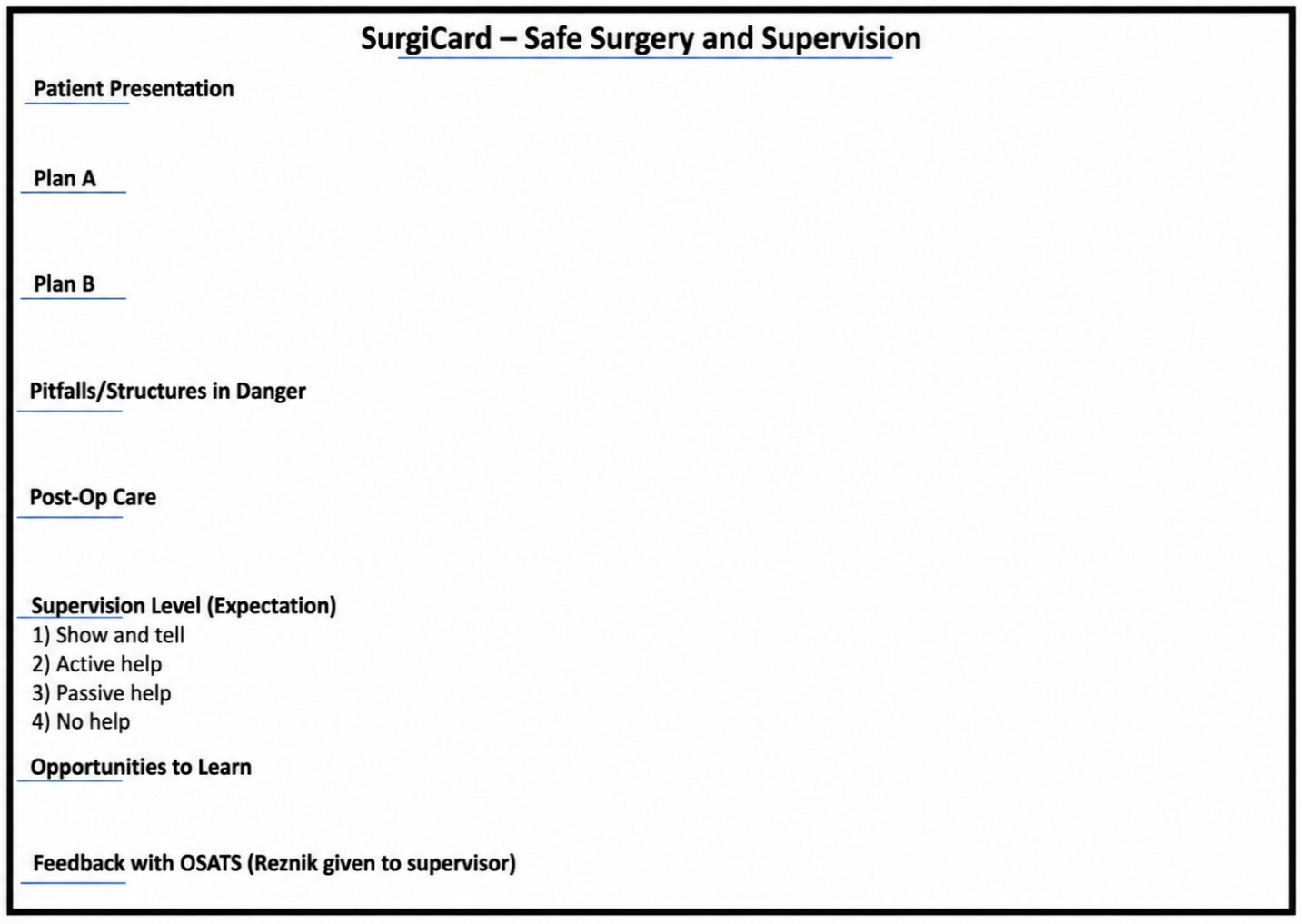
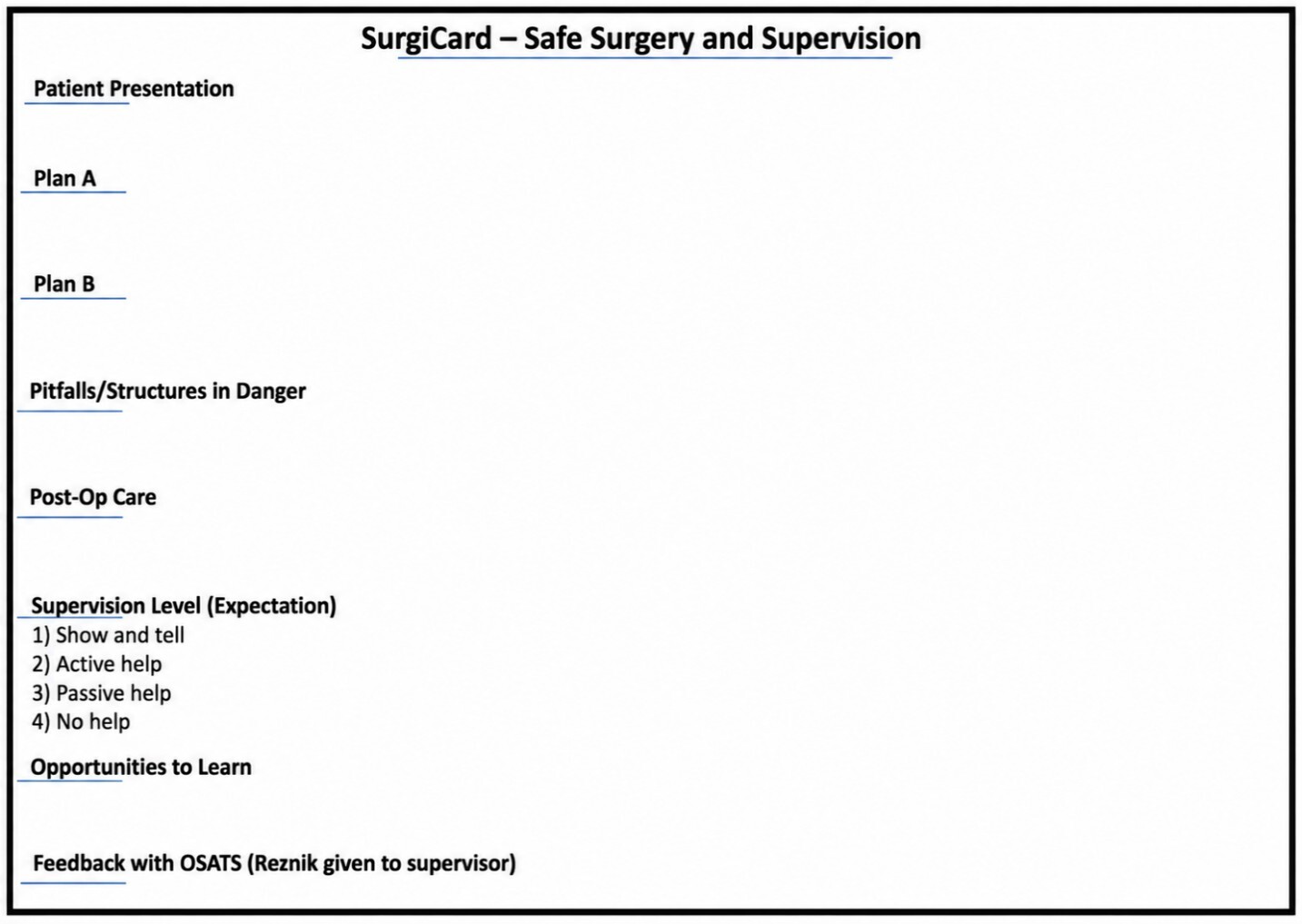
We developed SurgiCard before the baseline OREEM assessment, based on published literature and departmental clinical experience. The pocket-sized tool structures preoperative preparation and helps supervisors match supervision to each surgical trainee’s skill level and planned operative responsibilities (Figure 2). The surgical trainee completes SurgiCard preoperatively. Prior to surgery, the surgical trainee and supervisor review the card together to discuss the planned procedure and align expectations regarding operative responsibilities and supervision level. The agreed responsibilities and supervision level guide intraoperative participation and assistance. Supervisors use the Objective Structured Assessment of Technical Skill (OSATS) global rating scale to assess operative performance.11 After surgery, the surgical trainee and supervisor exchange feedback based on the SurgiCard plan and OSATS global rating.
Results
Seventeen participants completed the baseline OREEM questionnaire: 10 surgical trainees and seven specialists in plastic and reconstructive surgery.
Responses to selected OREEM items are presented in Table 1. At baseline, 100% (17/17) of the participants agreed or strongly agreed that they got along well with their supervisor, and 77% (13/17) perceived the operating room atmosphere as pleasant. Twelve percent (2/17) of the participants reported that the planned operation had not been discussed prior to surgery with their supervisor, and 24% (4/17) reported that there had been no agreement regarding which parts of the procedure they would perform. Forty-seven percent (8/17) of participants reported not having enough opportunity to assist during surgery, and 18% (3/17) reported that their supervisor took away the instruments when they performed poorly. All participants (17/17) agreed that they understood what their supervisors were trying to teach them. Thirty-five percent (6/17) of participants felt that the supervisor expected them to perform at the supervisor’s level, and 29% (5/17) reported inadequate supervision for their level of training.
Eighteen percent (3/17) reported not receiving any feedback on their performance afterward, and another 18% (3/17) of participants were unsure whether they received feedback. Twelve participants (71%) disagreed that operations were too complex for their level, and nine participants (53%) agreed that the operating list contained appropriate cases for their training. Forty-seven percent (8/17) reported that senior residents or more experienced fellows reduced their opportunities to operate.
The mean overall OREEM score was 144.7/200 (72.4%, range = 112–170, SD = 17.1) (Table 2).
Subscale scores were 53.3/65 (82.0%, range = 43−60, SD = 4.4) for teaching and trainer (13 items), 33.3/55 (60.5%, range = 17−41, SD = 6.2) for learning opportunities (11 items), 29.8/40 (74.6%, range 18−37, SD = 5.8) for atmosphere (8 items) and 28.3/40 (70.7%, range 12−38, SD = 6.7) for supervisor, workload and support (8 items). Only four participants completed the first follow-up OREEM assessment. The low response prevented meaningful evaluation of changes following the SurgiCard implementation. Due to the low follow-up participation, the planned 12-month assessment was not conducted.
Discussion
Baseline OREEM results indicated positive supervisor-trainee relationships as well as gaps in learning opportunities, supervision, and educational structure. The mean overall OREEM score was 72.4%, compared with 79.2% reported by Rupani et al.9 Direct comparison is limited because our sample included both surgeons and surgical trainees, whereas Rupani et al. studied surgical trainees. The teaching and trainer subscale scored highest in our cohort at 82.0%, compared with 80.8% in Rupani et al. Learning opportunities scored lowest at 60.5%, compared with 72.9% while atmosphere and supervisor, workload and support also scored lower in our cohort. These descriptive differences should be interpreted cautiously given the small sample and differences in participant composition. SurgiCard was developed from published literature and departmental experience before the baseline assessment; the findings subsequently supported its focus on operative planning, responsibilities, supervision, and feedback.1–6
Limited preoperative discussion may reduce surgical trainees’ perception of supervisor engagement because learning objectives and operative responsibilities are unclear. Unclear operative responsibilities may also limit perceived autonomy and opportunities for hands-on experience. SurgiCard is intended to improve communication by structuring discussion of the operative plan, supervision, learning objectives and surgical trainee responsibilities.
Educational structure and communication may represent modifiable barriers alongside limitations in operative opportunities.1,12,13 Our findings are consistent with Dick et al., who identified structured feedback, assessment of both technical and non-technical skills, and longitudinal monitoring of surgical trainee development as key priorities in modern surgical education.14 The expert panel in the TEST study emphasized that operative performance assessment should extend beyond technical proficiency to include communication, situation awareness, and decision-making. Performance metrics were considered most valuable when used to guide feedback, identify learning needs, and monitor progression over time. Connolly et al. reported greater resident satisfaction with feedback frequency and quality after introducing a feedback card.3 Standardized tools such as SurgiCard may support a more consistent approach to operative planning, supervision, and feedback. Whether this improves educational outcomes across settings requires further evaluation.
Limitations
This study was limited by its small sample from a single department. The inclusion of both surgeons and surgical trainees limits comparison with studies involving only trainees and warrants caution when interpreting scores from an instrument developed for surgical trainees. Use of the English-language OREEM may also have affected participants’ interpretation of questionnaire items. The assessment relied on self-reported perceptions rather than direct observation of teaching practices, operative participation, or surgical performance. High trainee turnover and low follow-up participation prevented meaningful evaluation of SurgiCard’s effect.
Conclusions
Baseline OREEM findings identified specific gaps in learning opportunities, supervision, preoperative planning, and feedback. SurgiCard provides a structured framework for aligning operative plans, surgical trainee responsibilities, supervision, and feedback, but low follow-up response prevented evaluation of its effect. Larger prospective studies are needed to determine whether SurgiCard improves surgical training outcomes.
Ethics
The study was registered with Region Zealand (P-2024-16274) and conducted in accordance with the Declaration of Helsinki. All participants provided written informed consent, and data were anonymized. Under Danish legislation, the project did not require ethical approval.15