Introduction
Cardiothoracic surgery (CTS) requires expert proficiency in technical skills, operative judgement, and adaptability. Traditional apprenticeship-based training is increasingly constrained by service pressures, patient complexity, reduced operative exposure, and variable access to supervised experience. These challenges have strengthened the need for structured educational approaches that accelerate skill acquisition while maintaining patient safety.
Deliberate practice (DP), originally described by K. Anders Ericsson and colleagues, refers to engagement in structured activities specifically designed to improve performance within a domain.1 In contrast to routine clinical exposure or simple repetition, DP is purposeful, effortful, and directed toward specific performance gaps. Its essential components include clearly defined and measurable goals, repetitive practice of targeted tasks, immediate and informative feedback, opportunity for error correction, objective assessment, reflection, and progressive challenge matched to the trainee’s level of competence. In CTS training, these elements are particularly important because technical proficiency must be integrated with procedural flow, decision-making, and patient safety.
Simulation can support DP by providing a safe environment for repeated practice, feedback, and graded progression; however, simulation alone does not constitute DP. Rather, simulation is a training tool, whereas DP is an educational method that requires defined objectives, expert guidance, and assessment. Available modalities range from low-fidelity bench and part-task trainers to tissue-based, animal, cadaveric, three-dimensional printed, high-fidelity, virtual, augmented, and mixed reality platforms. Low-cost models may be sufficient for early acquisition of fundamental skills such as suturing, knot tying, cannulation, conduit handling, and anastomosis, whereas tissue-based or high-fidelity models may better support procedural integration, tactile realism, and crisis rehearsal. Emerging digital platforms may add scalable, data-rich assessment, although evidence of clinical transfer remains variable.
No single simulation modality is sufficient for CTS training. The optimal approach is likely a longitudinal, multimodal curriculum in which lower-cost models support early repetitive skill acquisition, higher-fidelity or tissue-based models support procedural complexity, video review facilitates reflection and coaching, and supervised operative experience consolidates transfer to clinical practice.2–8 For DP to be educationally meaningful, activities must be embedded within a curriculum that specifies the skill to be practised, the expected outcome, the feedback process, and the criteria for progression.
This scoping review evaluates the current application of DP in CTS training, including its impact on technical skill acquisition, trainee confidence, operative performance, and patient outcomes. It also aims to identify implementation barriers and highlight future directions for research and curriculum development.
Methods
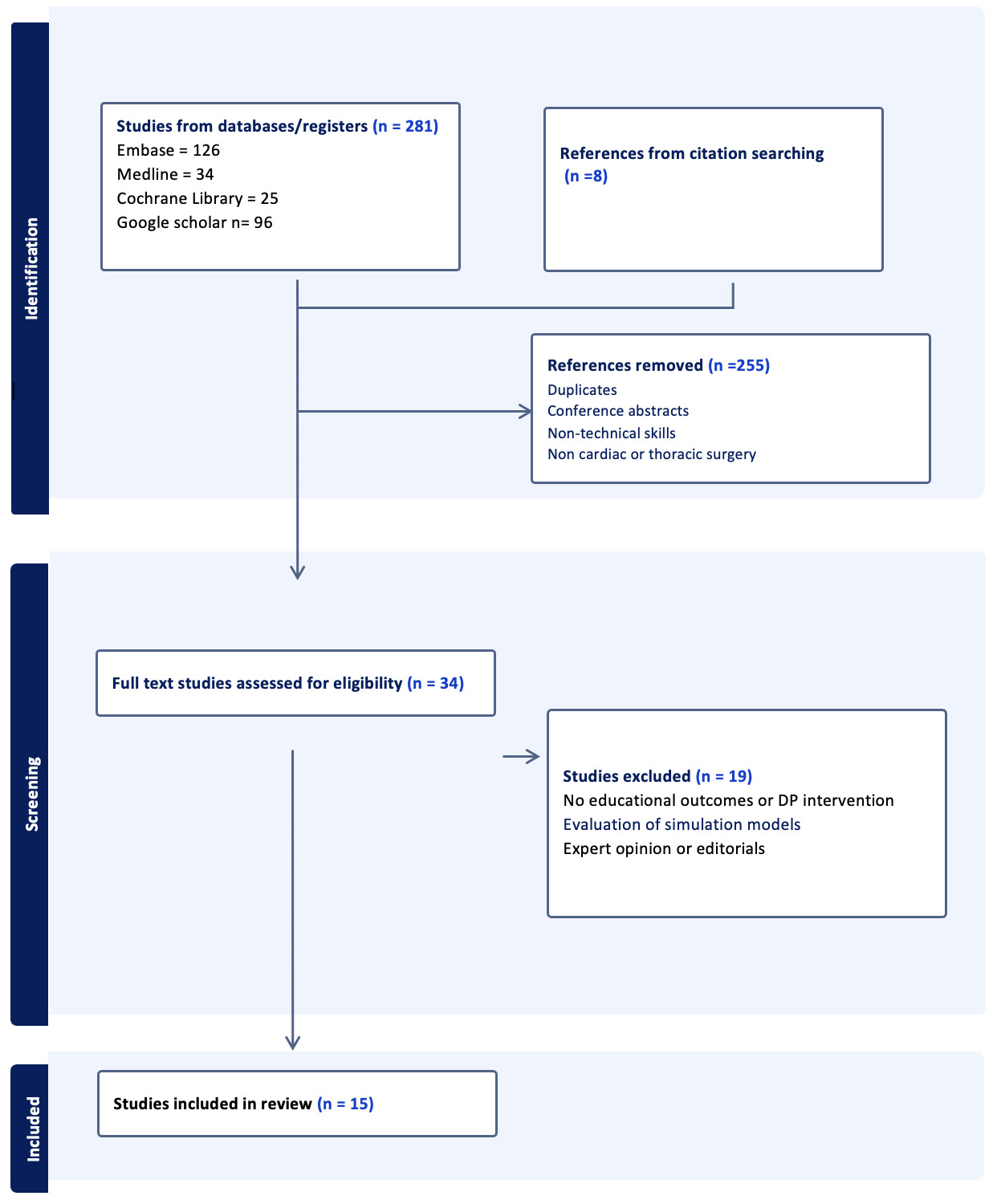
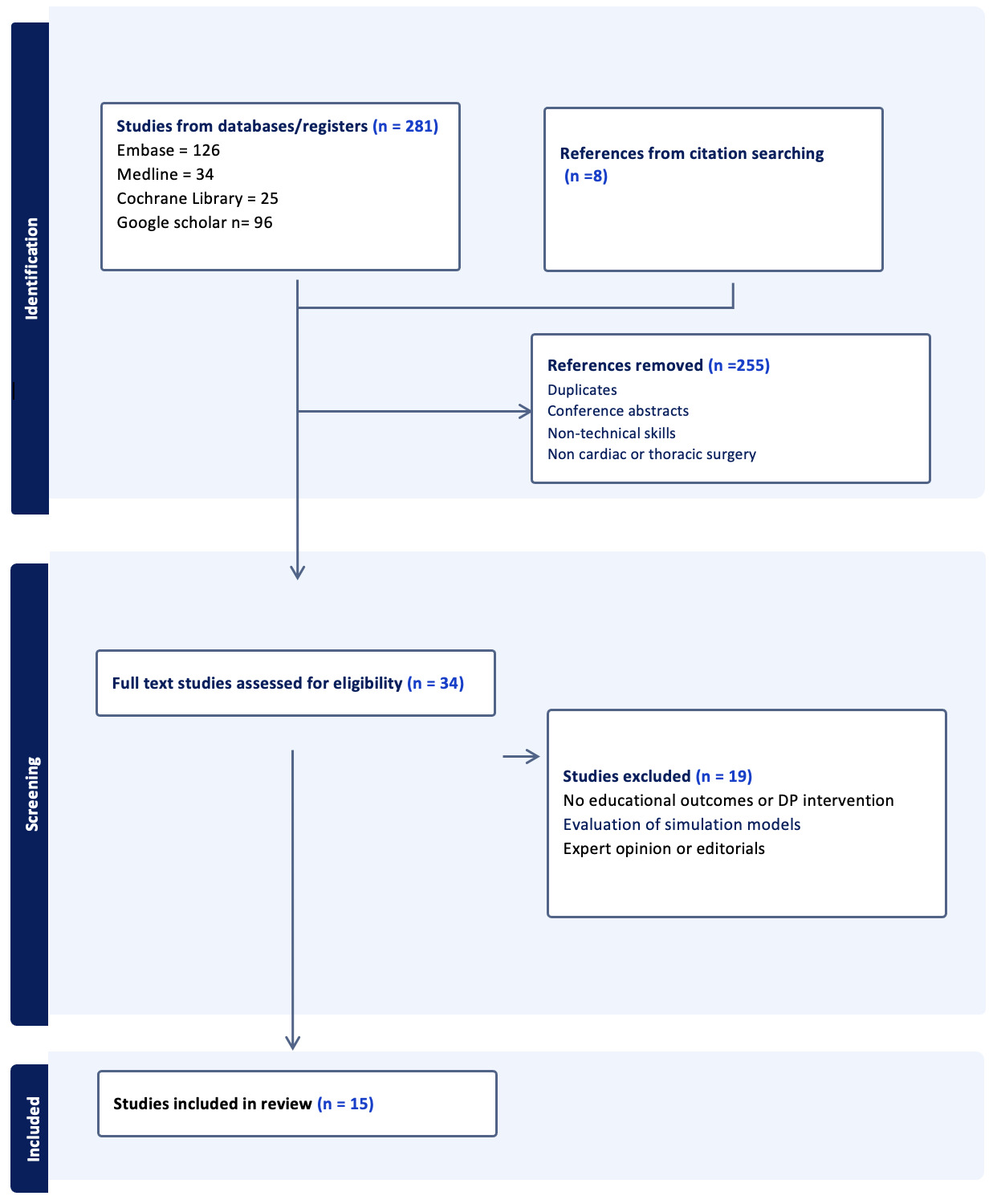
Study identification: A comprehensive search of medical literature databases (including Medline, Embase, Cochrane Library and Google Scholar) was conducted to identify studies published on DP in CTS training in the last fifteen years until September 2025. The search limited to English language journals.
Inclusion criteria were broad to capture the full spectrum of evidence, including simulation-based studies, training curricula and qualitative investigations. Original articles and reviews describing the use of DP in cardiac or thoracic surgical training were included. Articles with no definable DP intervention, assessing the validity of a simulation model or assessing non-technical skills were excluded. To identify any additional studies, a snowball search was conducted of the citations and references of key articles. The search terms included: deliberate practice, surgical training, surgical education, cardiothoracic surgery, cardiac surgery, thoracic surgery.
Articles were screened for (i) title and abstract and (ii) full text by two independent reviewers (CV, TV) using the below inclusion and exclusion criteria. Conflicts between the reviewers were resolved through a third independent reviewer (PP). The scoping review was performed according to the Preferred Reporting Items for Systematic Reviews and Meta-Analyses guidelines for scoping reviews (PRISMA-ScR) (Figure 1).
Study characteristics
Six studies were conducted in the United States,3,4,9–12 three in the United Kingdom,5,6,13 two in Germany,14,15 one in Canada,2 one in Malaysia,16 one in Japan,7 and one in Belgium.17 There were six observational studies, including cross-sectional studies,4,11–14,16 two comparative studies,9,15 three randomised controlled trials,5,10,17 two systematic reviews,2,3 one scoping review,6 and one narrative review.7 Excluding the review studies, simulation modalities included animal-based models (n=4), non-tissue-based benchtop models including instructional videos and/or 3D technology (n=4), a mixed-fidelity simulation curriculum (n=1), and a high-fidelity simulator system (n=1).5
Studies assessed a range of CTS procedures including coronary and aortic anastomosis, aortic and mitral valve surgery, congenital cardiac surgery procedures, bronchoscopy and minimally invasive (MI) surgery. One study evaluated deliberate practice by allowing trainees to perform complete cases, mostly coronary artery bypass surgery and valve replacements, on patients under full supervision.9
Most studies included fewer than 20 participants and in the study by Mavroudis et al only a single trainee performed all twelve procedures in five neonatal piglet hearts over two and a half days.11
The list of studies can be found in Table 1.
Types of DP Interventions
The reviewed articles utilised a range of DP modalities including simulation based, video assisted learning, step wise procedural, and supervised live operating.
Simulation based DP
Simulation based studies included using various simulation modalities such as virtual reality simulators, bench top models such as plastic/silicone part-task models or mannequins, and animal tissue-based models (wet labs).3,10
Video assisting learning DP
Video assisting learning was used in a variety of ways through these reviews. Prior to starting a combination of tasks, two studies provided an instruction video.4,10 Multiple studies provided video recordings of the participant completing the task in question which were then graded by independent surgeons,4,10–12,15 with a few studies also including self-reflection and self-review of these videos.11,15
Step wise procedural training DP
Soppa et al used a standardised training approach with direct supervision where four trainees performed minimally invasive AVR operations. Prior to this, each trainee had completed a required minimum of five AVRs in the wet lab and/or standard AVRs. The operation had been divided into five parts; each trainee had to complete every step five times successfully prior to moving to the next step.13 Mavroudis et al used a similar method.11
Supervised live operating DP
Tolis et al examined the feasibility and safety of CTS trainees as primary operators by comparing 100 cardiac surgeries performed by trainees under supervision with matched cases performed by a single attending surgeon.9
Results
Technical skill acquisition
Most of the included studies demonstrated an improvement in technical skill acquisition following DP-based interventions.2–4,6,7,10–12,15 Less experienced trainees on average showed a steeper increase in performance than more experienced or senior trainees.2,10,12,15
Several studies have shown that when trainees assume a more autonomous role, aside from developing muscle memory, real-time correction by an instructor results in improved skill.11
One study showed that DP-structured simulation training produced rapid improvement in skill acquisition across every skill level cohort, with retention of skills while progressing from low-fidelity to high-fidelity simulations.15
Another study summarised the skill acquisition process of achieving expert status and how it can be applied to cardiovascular surgical training, identifying DP as a method for achieving surgical excellence while emphasising that curriculum and training-environment improvements are also required.7
Confidence and self-efficacy
Engelhardt et al showed that even with a single DP session on mitral valve reconstruction, trainees’ surgical skills significantly improved and all beginner participants reported increased confidence at the end of the session.14 Similarly, in a cross-sectional study by Yean et al, MI mitral and aortic surgeries performed on a self-designed simulation tool increased trainees’ self-reported confidence after the workshop.16 Multiple studies showed consistent improvements in trainee performance, retention, recall and confidence with DP, often delivered through simulation-based medical education.6,11
Feedback and supervision
Feedback is central to DP because it identifies errors, guides correction and directs progression. Across studies, trainees valued skilled trainers who provided direct observation, immediate feedback and objective performance assessment, particularly when supplemented by video review or metrics.7,8,11,14,15
Patient outcomes and transfer to clinical practice
Several studies reported improved learning outcomes with DP.3,6 Importantly, available clinical studies did not show compromised patient safety. Tolis et al reported longer operative, bypass and cross-clamp times for trainee-performed cases, but no significant difference in postoperative outcomes compared with matched consultant cases.9 Some evidence also suggests transfer of improved skill and confidence into clinical practice.6,11,17
Neutral findings
Smelt et al found no significant difference between a cardiopulmonary bypass complications simulation session and a one-hour lecture.5 This neutral result should be interpreted cautiously. Both groups received structured teaching and improved, suggesting benefit from formal instruction regardless of modality. The study may also have been limited by small sample size, variable baseline exposure and reliance on written multiple-choice testing, which may not capture crisis management, technical performance, communication or behaviour under pressure. The simulation was a single session rather than a longitudinal DP programme with repeated attempts, feedback, error correction and progressive complexity. Thus, the finding suggests not that simulation is ineffective, but that brief high-fidelity simulation assessed mainly by knowledge testing may not outperform good didactic teaching unless embedded in a deliberate, feedback-rich curriculum.
Barriers and Limitations
The high cost of some simulation models and low fidelity of materials is a common limitation for the studies.4,17 Smelt et al used a high-fidelity simulator with higher cost, but this did not produce a statistically significant improvement compared with CTS trainees who attended a one-hour lecture instead.5
CTS surgeons perform as primary operators within teaching hospitals due to factors such as case complexity, acuity, patient request, service demands, work-hour restrictions and access to experienced supervisors.5–7,9,13
Discussion
This scoping review consolidates dispersed CTS-specific evidence on DP and distinguishes DP as an educational method rather than a simulation modality alone. By mapping studies across cardiac, thoracic, congenital, minimally invasive and bronchoscopy training, it identifies common features associated with benefit, including specific goals, repeated task performance, expert feedback, objective assessment and graduated complexity. It also highlights key gaps: few high-quality comparative studies, small cohorts, inconsistent outcome measures, limited patient-centred outcomes and scarce long-term data on retention or transfer to operative performance. The review therefore provides a practical synthesis for CTS educators and identifies priorities for research beyond feasibility and short-term skill acquisition.
Despite the encouraging findings, most studies are limited by small sample sizes, heterogeneous intervention designs, and potential publication bias.2–4,6,7,10–12,14–17 In addition, there is a lack of objective patient outcome data and limited evidence on long-term skill retention, highlighting the need for longitudinal research to better establish the impact of DP on clinical outcomes.6,9,11,17
The results of this review suggest that structured DP interventions facilitate more rapid skill acquisition across all levels of training, supporting early integration into CTS curricula.2–4,6,7,10–12,14–16 Notably, these interventions do not necessarily require high-fidelity simulation, as lower-cost models appear effective for initial skill development.4,12,15 Simulation provides a safe environment for repetitive practice and error correction; however, it cannot fully replicate the complexity, variability, and cognitive demands of live operative settings. As such, simulation should be viewed as complementary to, rather than a replacement for, supervised operative experience.9,13
Within the Australia and New Zealand CTS training programme, opportunities for DP remain largely ad hoc and are not formally embedded within the curriculum. Consequently, trainees are often required to seek additional learning opportunities independently, frequently with limited access to consistent, high-quality feedback despite evidence emphasising its critical role in skill progression.7,8,11,14,15
Effective curricular adoption of DP requires structured guidance rather than informal implementation. Programmes should specify which technical and cognitive skills are suited to DP, when activities occur within training, required supervision, and progression criteria. Each session should have predefined outcomes linked to curriculum milestones, such as technical accuracy, procedural efficiency, error recognition, operative judgement or readiness for more complex tasks, assessed using defined methods and metrics such as validated rating scales, procedure-specific checklists, direct observation, video review, simulation performance data or entrustment-based assessments. DP topics should be selected by trainer consensus, considering the trainee’s level, prior operative and simulation exposure, performance gaps and expected progression. Without this structure, DP risks becoming unsupervised repetition or isolated simulation workshops rather than goal-directed, feedback-rich practice.
Implementation is limited by faculty workload, resource allocation, curriculum crowding and variable engagement. Trainers often provide additional intraoperative supervision, simulation teaching and feedback outside routine clinical duties, yet this educational work may not be formally recognised. Sustainable DP integration will therefore require institutional support, protected teaching time, feasible scheduling and recognition of consultant contribution.
A well-designed DP curriculum has the potential to accelerate skill acquisition, optimise operative efficiency, and improve progression toward competency milestones. However, successful implementation will require not only structural changes to training programmes, but also institutional support, protected teaching time, and recognition of the educational contributions made by surgical faculty.
Future Directions
Future work should tailor DP to trainee stage and individual needs, supported where appropriate by adaptive technologies, artificial intelligence-guided simulators, surgical coaching and video review.18,19 Research should prioritise longitudinal clinical outcomes, cost-effectiveness, implementation in resource-limited settings and improved feedback and assessment tools.
Practical implementation may also require appropriate recognition of consultant time, including remuneration for additional training responsibilities or extended operative involvement. Future research should therefore prioritise longitudinal evaluation of clinical outcomes, cost-effectiveness analyses of simulation and structured practice interventions, implementation strategies for resource-limited settings, and continued innovation in feedback and assessment, particularly through digital and virtual tools.
Conclusion
DP has emerged as a cornerstone of modern CTS training, offering a structured, evidence-based approach to skill acquisition and mastery. In the Australia and New Zealand context, wider adoption of DP will require formal curriculum integration, protected teaching time, and recognition of faculty effort. Future work should focus on sustainable implementation strategies and longitudinal evaluation to determine how DP can best strengthen surgical training and ultimately deliver the highest standard of patient care.